Propred
High throughput screening of protein molecules and their formulations is a critical step in protein drug development. Conventional strategies are time consuming and labor intensive, making them inadequate for high throughput screening workflows. Emerging high throughput screening approaches on the market are based on protein Tm or Tagg values, which have proven effective for evaluating the stability of protein molecules and their formulations. PROPRED is a high throughput instrument that assesses the stability of protein molecules and formulations by measuring protein structural changes, dispersion, and aggregation across low to high temperature ranges. Its detection principle relies on fluorescence spectroscopy and light scattering techniques, long established general methods for determining molecular weight, aggregate size, and stability of proteins and other substances in solution.
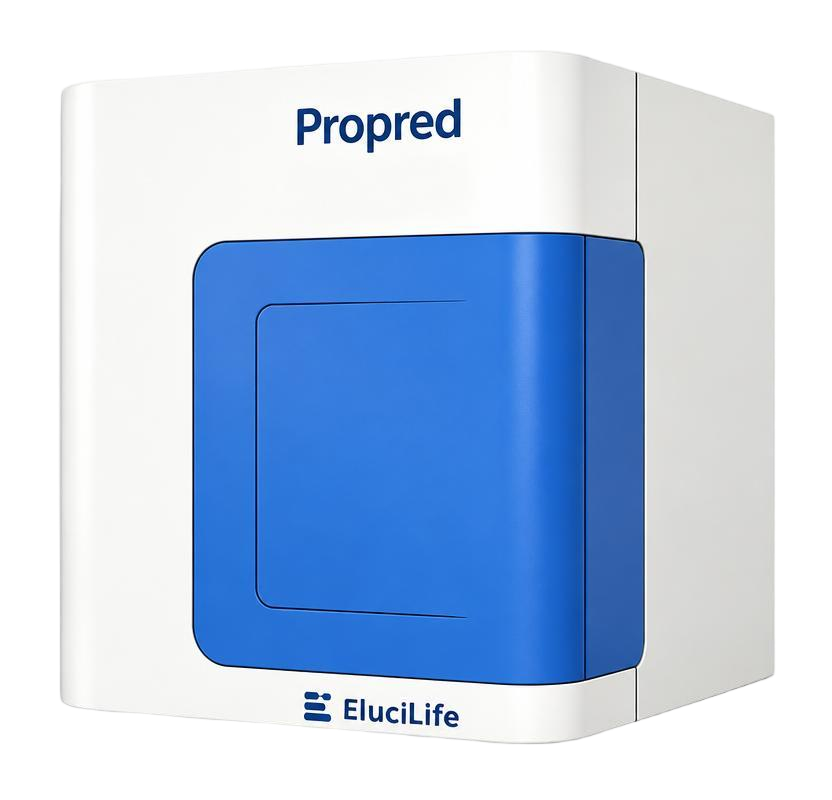
PROPRED Overview
High throughput screening of protein molecules and their formulations is a critical step in protein drug development. Conventional strategies are time consuming and labor intensive, making them inadequate for high throughput screening workflows. Emerging high throughput screening approaches on the market are based on protein Tm or Tagg values, which have proven effective for evaluating the stability of protein molecules and their formulations.
PROPRED is a high throughput instrument that assesses the stability of protein molecules and formulations by measuring protein structural changes, dispersion, and aggregation across low to high temperature ranges. Its detection principle relies on fluorescence spectroscopy and light scattering techniques, long established general methods for determining molecular weight, aggregate size, and stability of proteins and other substances in solution.
Application Principle of PROPRED
Protein denaturation aggregation rate refers to the increase in protein aggregates per second, a parameter that accurately reflects protein stability under given environmental conditions. Through continuous real time measurement, PROPRED enables direct, dynamic monitoring of sample aggregation rates during the aggregation process, supporting screening of protein molecules and formulations.
Aggregation Rate (Ar):
Ar = d(MW/M₀)/dt
• MW: instantaneous average molecular weight
• M₀: initial average molecular weight
An Ar value of 0.004858 s⁻¹ means the quantity of aggregates in the sample increases by 0.4858% per second.
PROPRED Technical Features
• Two banks of sample chambers with a total of 40 positions; temperature control range: 15 °C 95 °C; simultaneous measurement of up to 40 samples.
• Independent heating and stirring system for each sample chamber; stirring speed adjustable from 0 2000 RPM.
• Sample volume range: 0.02 3.5 mL; two types of sample cells available.
Addressing Protein Denaturation and Aggregation
Two step model:
Unfolding
Diffusion Controlled Aggregation
Denaturation Aggregation Kinetics: Temperature and Stirring
• Temperature dependent aggregation rates for monoclonal antibodies
• Aggregation rate dependence on stirring versus temperature
PROPRED Application Examples
Formulation Stability Study
Protein samples exhibit different aggregation rates under different formulation conditions. PROPRED accurately measures aggregation rates and stability for multiple samples simultaneously, providing powerful support for formulation screening.
Aggregation rate based stability evaluation of one protein under three distinct formulation conditions.
In one formulation development case involving four influencing factors: trehalose, pH, NaCl, and Buffer C, a Design of Experiments (DOE) approach was used for 25 formulation groups. Aggregation rate measurements combined with Pareto analysis identified the optimal formulation recipe, completing the workflow within one week.
• Pareto analysis of aggregation rates for 25 formulations at 50 °C
• Theoretical optimal formulation derived from PROPRED measurements: Trehalose: 7.5 wt% NaCl: 80 mM Buffer C: 20 mM pH: 6.5 Predicted Tm = 69.3 °C
Key Factors Driving Aggregation and Degradation in Protein Products or Natural Products
Multi dimensional sample analysis deepens understanding of sample stability. PROPRED monitors time dependent sample behaviour in solution induced by variables such as stirring rate and temperature.
• SEC detected aggregates in UV irradiated samples over time; real time aggregate detection by PROPRED under identical conditions (red curve).
• PROPRED controls protein aggregation rates by adjusting stirring speed and liquid air interfacial exposure conditions.
Average Molecular Weight Measurement
PROPRED measures absolute average molecular weights under different sample states to quantify aggregation levels. Theoretical measurable molecular weight range: 1000 1 000 000 g/mol.
Software Interface
PROPRED features an intuitive, well structured graphical user interface with rational layout and rigorous workflow logic. The design lowers entry barriers, enabling both novice and experienced researchers to operate efficiently. Optimized system operation reduces human error risk and ensures smooth experimental workflows and reliable results.
Comprehensive process monitoring functions include real time status indicators and fully traceable data logs to enhance experimental reliability and process control. Beyond instrument control and monitoring, the software delivers powerful data processing tools including peak fitting, peak deconvolution, integration, differentiation, and multi curve overlay analysis. These advanced tools precisely characterize catalyst surface properties, acid base active site distribution, activation energy, reaction kinetics and other key parameters to reveal complex catalytic behavior.
Product Specifications
Fluorescence, luminescence, static and dynamic light scattering
Low-stray-light Monk-Gillieson monochromator; holographic grating. Excitation solid-state lasers: 260 nm, 405 nm, 650 nm. Emission range: 200-800 nm, zero-order selection (standard photomultiplier tube). Synchronous scanning at constant wavelength or constant frequency offset; automatic excitation-spectrum correction. Excitation filter wheel integrated in optical path with built-in 390 nm cutoff filter. Excitation and emission polarizers fitted with two filter wheels, each containing vertical- and horizontal-polarizer elements.
±1 nm
±0.5 nm
Variable slits: excitation slit 2.5-15 nm; emission slit 2.5-20 nm; 0.1 nm step
10-1500 nm/min, 1 nm step
Computer-selectable cutoff filters: 290 nm, 350 nm, 390 nm, 515 nm; blank filter; 1% attenuator
1-40
0.1 °C/min-10 °C/min
50 μg/mL
50 μg/mL-150 mg/mL
20 μL-500 μL; compatible with all buffer conditions
1st-4th order derivatives, area under curve, emission peak wavelength, emission-peak ratio, etc.
Yes
Tm (structural stability), Tagg (aggregation stability), ΔG, ΔΔG, Cm (chemical stability), isothermal stability, denaturation-renaturation analysis, viscosity; particle size, light-intensity distribution, mass distribution, dispersity coefficient, anisotropy
Intel Pentium 4 1.6 GHz or equivalent processor; minimum 8 GB RAM; minimum 16-bit, 1280 × 768 high-color display; minimum 1 TB hard-disk capacity; at least one RS232 port and one USB port. Operating system: Windows® 7 or higher, 32-bit English-language system
90-132 VAC, 50/60 Hz, 2 A; 200-264 VAC, 50/60 Hz, 1 A. Ambient operating temperature: 15-40 °C; relative humidity: 10-65% (non-condensing)
49.5 kg
26.5 cm × 79 cm × 68 cm